
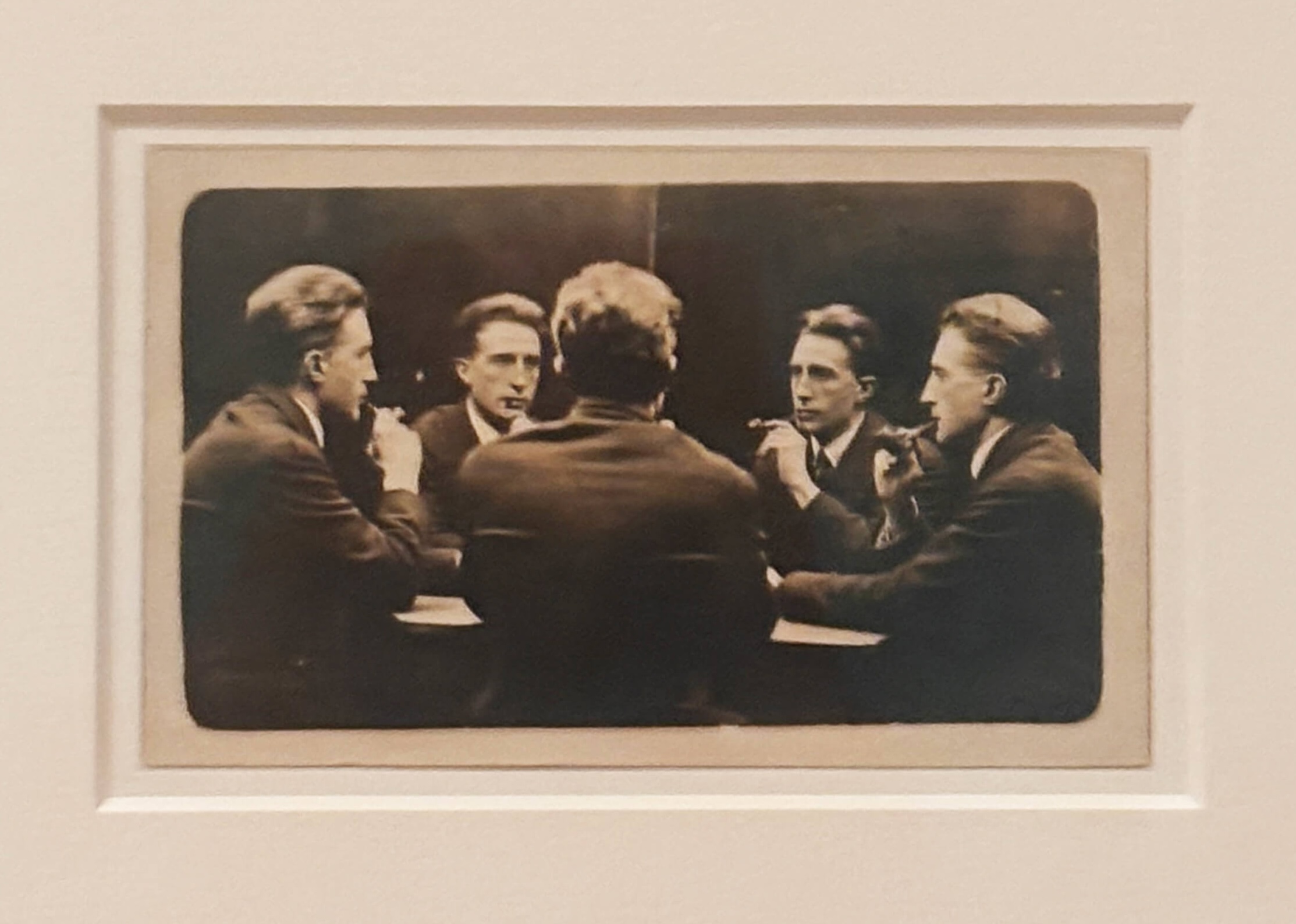
Most museum-goers know the readymade Fountain, many recognize Nude Descending a Staircase. Fewer may know of his boxes containing miniature replicas of his own work, his precision optics, his glass sculptures, or his lifelong fascination with chess.
The exhibition features over 300 pieces by the artist and traces Duchamp from his early paintings and encounters with Cubism through his glass works, found objects, photographs, ready-mades, and experiments with perception. Nude Descending a Staircase, which would go on to achieve enormous renown, was famously rejected by fellow artists at the 1913 Armory Show (where it was subjected to a level of intellectual scrutiny and critical rigour that can feel woefully lacking amid today’s increasingly commercialised art fairs). Walking through the exhibition, surrounded by so many works, it became apparent just how far his shadow reaches; his influence is apparent in artists like Jasper Johns, Robert Rauschenberg, Joseph Cornell, and Andy Warhol. Even in John Baldessari and Gerhard Richter. This vast collection of works, whether intentionally or not, highlighted just how much he shaped the artists that worked in the years following. Although the enormity of the exhibition was at times overwhelming, it served to show Duchamp as something so much more than the man who made the readymade, or the man who declared that anything could be art. It highlighted him as a painter, a sculptor, a thoughtful inventor, and someone who cared deeply enough about art to challenge it and participate in the growing dialogue about the future of the art world.
Throughout his career, Duchamp continued to invent and reinvent, even working under the alter ego Rrose Sélavy, and eventually cultivating an image of inactivity and distance from the art world. The exhibition begins with a quote from Duchamp recalling that he grew up in an “aesthetic bath”, describing his early years as “swimming lessons” as he was completely immersed in the arts. Near the end of the exhibition, he describes his later life: “I suppose you could say I spend my time breathing... I am a respirateur – a breather. I enjoy it tremendously.” Yet during the very period in which, as the exhibition text says, he “cultivated an appearance of inactivity”, Duchamp was secretly working on Étant donnés, his final major work. The exhibition concludes with photographs documenting Étant donnés in progress. The setup is such that one almost expects to encounter the work itself on the way out, but it remains permanently installed at the Philadelphia Museum of Art and cannot be moved. A separate journey will have to be made there to see this piece.
There is something fitting about ending with a work that Duchamp made largely in private and did not intend to be seen during his lifetime. After spending his career questioning the boundaries of art, Duchamp ultimately blurred the boundaries between art and life until they could no longer be separated. One walks away thinking that he was not an artist who believed anything could be art, but rather one who believed there was art to be found in everything. What began as swimming lessons had, by the end of his years, become as natural as breathing.
Marcel Duchamp
Apr 12–Aug 22, 2026
MoMA, Floor 6 -The Steven and Alexandra Cohen Center for Special Exhibitions
New York City